History
Erie history: the greatest coal town in Colorado
A homestead named for a Pennsylvania hometown, a railroad spur, eighty years of underground coal, a schoolhouse that became Town Hall, and a farm town that grew by two-thirds in a decade. The short history of Erie, with each claim resting on a source.
Erie exists because of coal. Settlers came to the Coal Creek valley after the gold rush, and coal was found in the seams under the prairie in the mid-1860s. Richard Van Valkenburg, one of the early arrivals, named the settlement for his former home of Erie, Pennsylvania. The Denver Pacific spur reached it in 1870, the Denver & Boulder Valley Railroad in 1871, and the town incorporated on November 16, 1874. The first official underground mine opened in 1876 under Ira Austin, and by 1895 Briggs Street had eleven saloons.
Eighty years underground
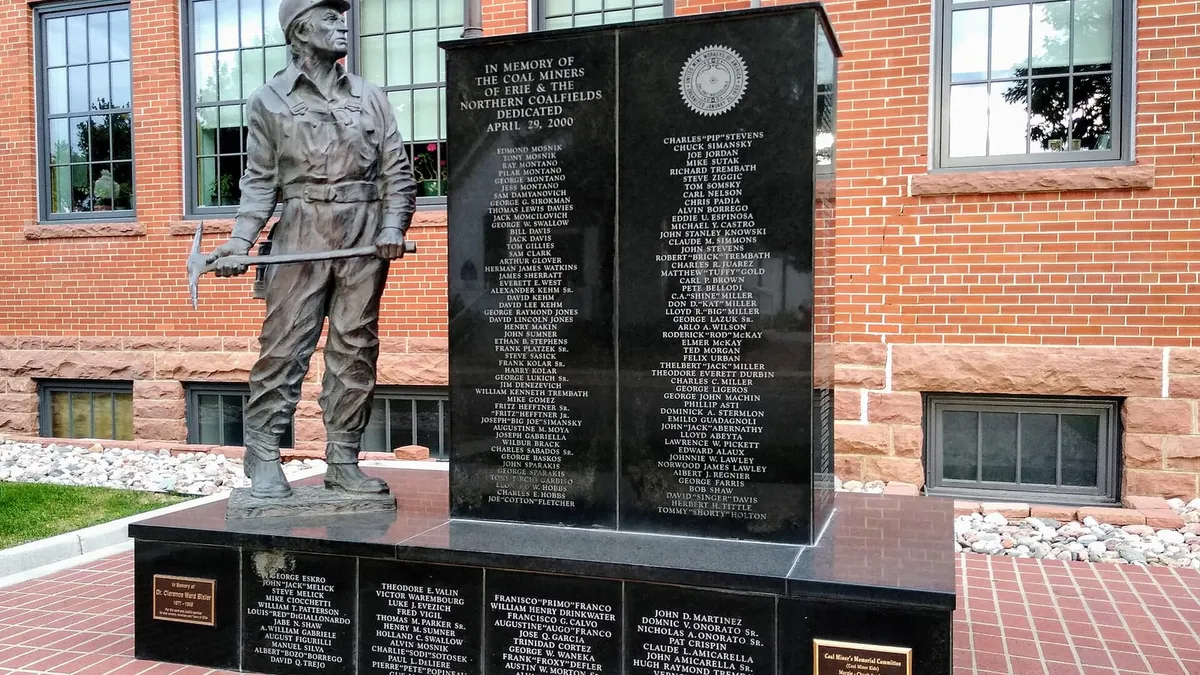
For the next eighty years Erie was, in its own description, the greatest coal mining town in Colorado, the center of the Northern Coalfield that ran from Marshall to Frederick. The mines and the camps around them (Puritan Camp, whose miners’ homes were photographed for the federal government, was one) drew miners from across Europe and Mexico, and their names are on the black granite of the Coal Miners’ Memorial outside Town Hall, dedicated on April 29, 2000, with a bronze miner standing over more than 500 of them. The town’s civic buildings are from the mining years: the two-storey 1889 Davis building on Briggs Street that now holds the Old Mine, the 1906 Lincoln School on Holbrook Street, the 1930 City Hall with its fire bell tower. Most of the mines closed by 1960; the last, the Eagle Mine, shut in 1978.
The farm town
With the coal gone, Erie was a farm town of a few thousand people for the next generation, and its oldest houses tell that story too. Oliver and Adaline Wise came from Wisconsin in 1869, patented their homestead on Jasper Road in 1870 and built the Western Victorian farmhouse that the Erie Historical Society opened as the Wise Homestead Museum in 2007, one of the oldest frame houses in Boulder County. Coal Creek, which floods, got a dike after 1972. The Lincoln School taught the town’s children until 1966 and sat empty until the Town renovated it as Town Hall in 1998.
The town that grew by two-thirds
The 2020 census counted 30,038 people in Erie, up 66 percent from 2010, spread across 19.8 square miles and two counties (17,387 in Weld, 12,651 in Boulder). Almost all of that growth is subdivisions built on former farmland on every side of the old grid, and the public buildings followed: the Community Library in January 2008, the Community Center and Community Park on Powers Street, the singletrack park, and, most recently, the Town’s revitalization of Briggs Street, where the fire station became a brewery in 2014 and the block has filled with restaurants since.
Sources
- Erie, Colorado on Wikipedia: settlement, the name, the railroads, incorporation, the 1876 mine, the eleven saloons, the mine closures, the 2020 census and county split.
- Lincoln School / Erie Town Hall, History Colorado: the 1906 school, its closure in 1966 and renovation in 1998.
- Erie Historical Society: the Wise homestead and the museum’s opening.
- Wikimedia Commons descriptions of the Coal Miners’ Memorial, the 1889 Davis building and the 1930 City Hall.
- 5280, January 2023: Echo Brewing in the former fire station since 2014.


